How to Write Product Descriptions That Help Customers Buy
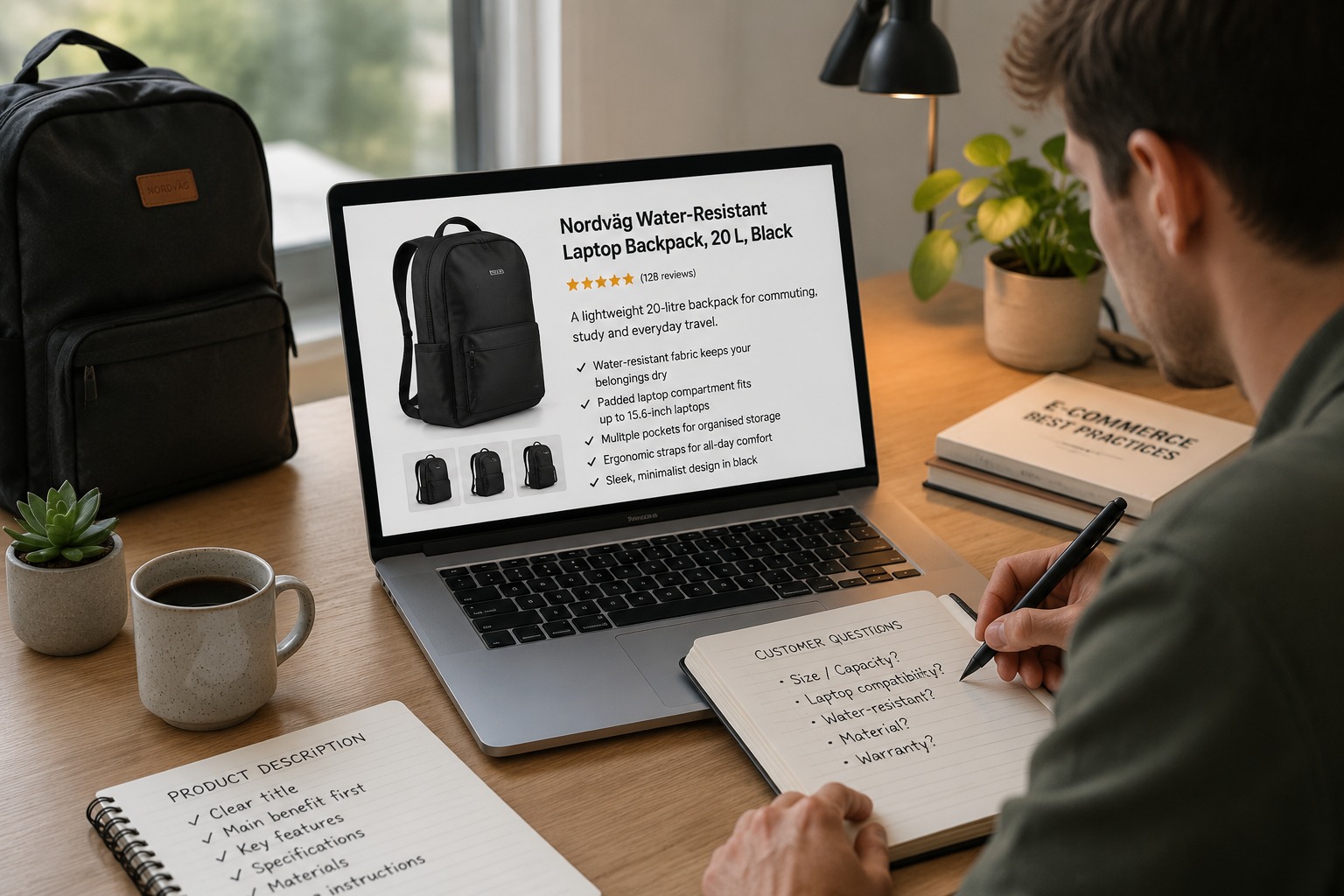
A good product description does more than fill space beneath a product image. It helps the customer understand what the product is, whether it meets their needs and why they should choose it.
Online customers cannot touch the material, test the size or ask a shop assistant an immediate question. Your product page must provide the missing information clearly and honestly. A useful description can improve customer confidence, increase relevant search visibility and reduce preventable returns.
This guide shows Swedish online sellers how to write product descriptions that are informative, persuasive and easier to discover.
1. Understand the customer before writing
Do not begin with the product. Begin with the person who may buy it.
Consider:
- Who is the product designed for?
- What problem or need brings that person to the page?
- Which details could prevent them from ordering?
- Which feature matters most to them?
- What words would they use when searching?
The same product may need different emphasis for different audiences. A parent buying a backpack may prioritise durability, comfort and easy cleaning. A commuter may care more about laptop protection, capacity and water resistance.
Choose one primary audience for each listing. Trying to appeal to everyone usually produces vague copy.
2. Write a clear product title
The product title should help customers and search engines identify the item quickly. Include the essential attributes without turning the title into a list of repeated keywords.
A useful structure is:
Brand or maker + product type + key feature + model/size/colour when relevant
Weak title:
Amazing Premium Bag Best Quality New
Improved title:
Nordv\u00e4g Water-Resistant Laptop Backpack, 20 L, Black
The improved title explains what the product is and includes information that can help the customer decide whether to open the listing.
Avoid:
- Writing the entire title in capital letters
- Unnecessary promotional words
- Repeating the same keyword
- Adding shipping promises that may change
- Including attributes that do not apply to every variant
3. Lead with the main customer benefit
The first one or two sentences should answer three questions:
- What is the product?
- Who is it for?
- What is its main practical benefit?
Example:
A lightweight 20-litre backpack for commuting, study and everyday travel. Its padded laptop compartment protects devices up to 15 inches, while the water-resistant outer fabric helps keep daily essentials dry during light rain.
This introduction gives the customer a reason to continue reading without using exaggerated claims.
4. Turn features into useful benefits
A feature describes the product. A benefit explains why that feature matters.
| Feature | Customer benefit |
|---|---|
| Padded laptop compartment | Helps protect the laptop from everyday bumps |
| Adjustable shoulder straps | Allows a more comfortable individual fit |
| Machine-washable cover | Makes everyday cleaning easier |
| Stainless-steel construction | Provides durability and resists rust |
| 500 ml capacity | Holds enough for a typical commute or workout |
Use both. Customers need accurate specifications, but benefits make those specifications meaningful.
Do not invent benefits that cannot be supported. A water-resistant product is not necessarily waterproof, and "natural" does not automatically mean safer or more sustainable.
5. Make descriptions easy to scan
Most customers do not read every word from beginning to end. Use a clear structure so important information can be found quickly.
A practical product-page order is:
- Short benefit-led introduction
- Key features
- Specifications
- Size, dimensions or fit
- Materials and care instructions
- Package contents
- Safety, compatibility or usage information
- Delivery and return information
Keep paragraphs short. Use bullet points for specifications, but do not turn the entire description into disconnected fragments.
6. Include complete product specifications
Missing information creates hesitation and returns. The details required depend on the product, but may include:
- Dimensions and weight
- Materials or ingredients
- Colour and finish
- Size and fit
- Capacity
- Model and compatibility
- Power, voltage or battery information
- Age recommendations
- Country of manufacture
- Care instructions
- Warranty information
- Certifications or safety warnings
- What is and is not included
Measurements should use formats familiar to Swedish customers, such as centimetres, kilograms and litres. Display prices in SEK for the Swedish market.
If a product has variants, make clear which information changes with the selected colour, size, material or model.
7. Use search terms naturally
SEO-friendly product descriptions are written for customers first. Choose a primary phrase that accurately describes the product and use it naturally in:
- The product title
- The first paragraph
- One relevant subheading where appropriate
- Image alt text
- The page title and meta description
- The URL
Add specific terms that customers may use, such as material, colour, size, use case or compatibility.
Do not repeat a phrase unnaturally. Keyword stuffing makes the listing harder to read and may reduce trust.
Weak:
Buy our best black laptop backpack. This black laptop backpack is the best laptop backpack for anyone searching for a laptop backpack.
Better:
This black 20-litre laptop backpack combines a padded device compartment with adjustable straps and a water-resistant exterior for everyday commuting.
8. Use original content
Copying a manufacturer's description may be convenient, but it can make your listing indistinguishable from many others. It may also omit the details your customers need.
Use manufacturer information as a factual reference, then create an original description based on the actual product. Verify specifications rather than guessing.
Original content can include:
- Who the product suits
- How it feels or functions in everyday use
- Compatibility details
- Clear dimensions
- Care advice
- Honest limitations
- Answers to frequent customer questions
Never copy another retailer's writing or images without permission.
9. Be accurate with prices, discounts and claims
Trust is more valuable than dramatic wording. Avoid claims such as "the best," "100% sustainable," "medical grade" or "guaranteed results" unless you have reliable evidence and the claim is legally permitted.
Swedish businesses must provide correct and clear price information. The total price normally needs to include VAT when products are marketed to consumers, and special rules apply when presenting price reductions. Review the current Konsumentverket price-information guidance.
Check that:
- The displayed price matches the selected variant
- Mandatory charges are not hidden
- A comparison or previous price can be supported
- The percentage discount is calculated correctly
- "Free“ offers do not contain unavoidable undisclosed costs
- Stock and delivery claims are current
10. Reduce returns by setting correct expectations
A description should help the right customer buy — not convince every visitor to order.
Mention details that could affect suitability:
- A garment runs small or has an oversized fit
- Natural materials may vary in colour or grain
- A device requires a separate adapter
- Assembly is required
- The item is sold individually rather than as a set
- Decorative objects in the photographs are not included
- Colour may look slightly different depending on the screen
Honest limitations can increase confidence and prevent disappointment.
Product-description template
Use this structure for your next listing:
Product title
Maker + product type + main feature + size/colour/model
Short introduction
Two sentences explaining what the product is, who it suits and its main benefit.
Key features
- Feature plus its practical benefit
- Feature plus its practical benefit
- Feature plus its practical benefit
Specifications
- Material:
- Dimensions:
- Weight:
- Colour:
- Capacity or size:
- Model or compatibility:
Care and usage
Explain cleaning, storage, assembly, charging or safe use.
Package contents
List exactly what the customer receives.
Important information
Add relevant limitations, warnings, differences between variants or items not included.
Complete before-and-after example
Weak description
Beautiful high-quality water bottle. Perfect for everyone. Best design and very strong. Buy now!
Improved description
A reusable 500 ml stainless-steel bottle designed for commuting, school and everyday activities. The double-wall construction helps maintain the drink's temperature, while the leak-resistant screw lid makes it easier to carry in a bag.
Key features
- 500 ml capacity
- Stainless-steel body
- Double-wall construction
- Leak-resistant screw lid
- Fits most standard cup holders
Dimensions: 25 × 7 cm
Weight: 310 g
Care: Hand-wash recommended. Not suitable for microwave use.
Package contents: One bottle and one lid.
The improved version is more persuasive because it is specific, useful and easier to verify.
Creating product listings on MarKood
MarKood vendors will be able to add product titles, descriptions, images, prices, inventory and relevant product details through the vendor dashboard. Complete and accurate listings can help customers compare products and make informed decisions.
Before publishing a product:
- Select the correct category
- Use original, high-quality images
- Check the title and description
- Complete all relevant attributes
- Confirm the price and VAT treatment
- Verify inventory
- Add accurate preparation and delivery information
- Preview the listing on mobile
Call to action: Apply to sell on MarKood
Publishing note: Confirm the final product-listing fields and link the call to action to the live vendor-registration page.
Frequently asked questions
How long should a product description be?
It should be long enough to answer the customer's important questions without repetition. A simple item may need only a concise description and specifications, while a technical product may require more detail.
Should every product have a unique description?
Yes. Each product and meaningful variant should have accurate, useful content. Avoid reusing identical text when important features differ.
Can AI write product descriptions?
AI can help create a first draft, but a person who understands the product should verify every specification, claim, measurement and legal requirement before publication.
Should keywords be repeated?
Use the main phrase naturally in important locations, but do not force it into every paragraph. Clarity and accuracy come first.
Do product descriptions affect returns?
They can. Clear sizing, compatibility, materials, package contents and limitations help customers choose more accurately and can reduce avoidable returns.